
1.There are a lot of different definitions of Design.
- Designing is a verb and a noun later.
- Creating value and meaning to life.
- A product means to an end and the end is how it relates to people.
- Designing is all about the appearance of the product. Now, that is not design. It becomes more of a decoration.
- A design is when it makes people capable of something to 1. read, 2. understand, 3. Experience. Now, Experience can be of two types, i.e, Desirable one and the Accessible one.
2. There is a certain way of designing things which we certainly call Design Methodology. There are 4 D’s of this methodology – Discover, Define, Develop and Deliver. Empathize—-Define—-Ideate—-Prototype—-Test Experience = Expectation – Actual Performance
Never kill any idea. Just deep freeze it.
3. Creative leap with design thinking– Empathize to know Connect to assimilate Metaphorize to communicate Visualize to build options Prototype to de-risk
4. Idiom Design and Consulting is a design firm and consultancy based in Bangalore, India.
Idiom is a design firm with varied design skills under one roof. At Idiom we incubate business ideas, ideas for societal transformation and ideas on life and living. Delivered, as strategy, as design output, as transformational tools and processes and as robust, ready-to-run businesses.

5. IDEO is an international design and consulting firm founded in Palo Alto, California, in 1991. The company has locations in Cambridge, Chicago, London, Munich, New York City, Palo Alto, San Francisco, Shanghai and Tokyo.
“Design thinking is a human-centered approach to innovation that draws from the designer’s toolkit to integrate the needs of people, the possibilities of technology, and the requirements for business success.” —Tim Brown, President and CEO of IDEO


6. IDEO’s method- Observation-Brainstorming-Prototyping-Implementation
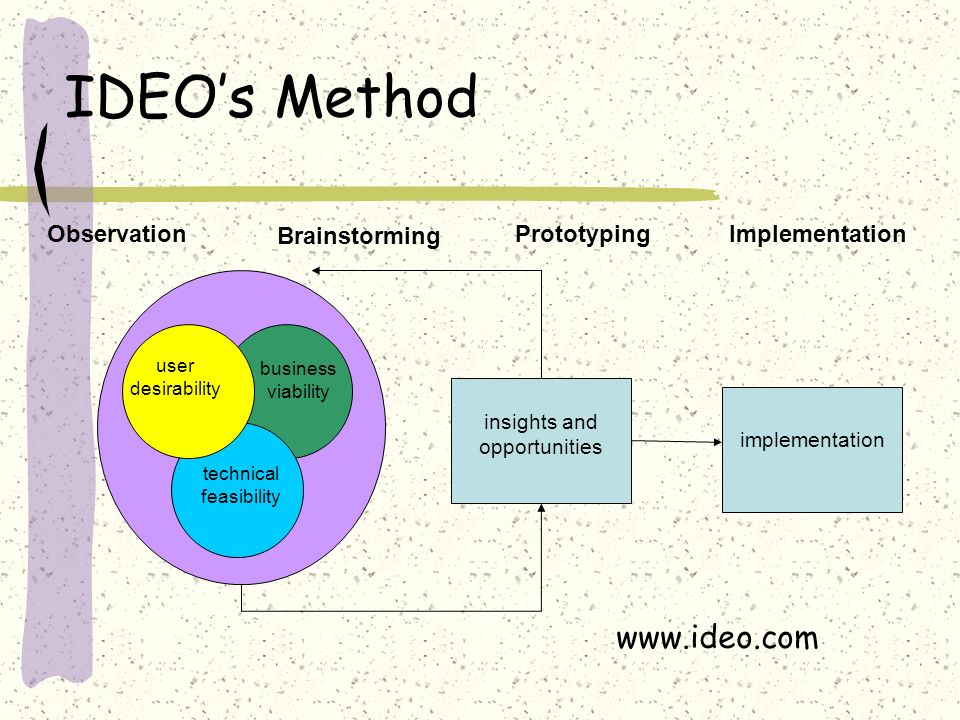
PHASE 0: Understand/Observe
- Study current market
- Current users
- Likes
- Dislikes
- Current techniques
- History
- Cost structure
- Current users
- Understand how things are
- Create feasibility record
- Other creative firms avoid this process
PHASE 1: Visualize/Realize
- Begin creating prototypes for potential solutions
- Rough
- Rapid
- Right
- Constant contact with client
- Full context of product users
PHASE 2: Evaluating/Refining
- Begin turning rough prototypes of foam into functional prototypes
- Shift from human factors/needs to engineering
- Resolve technical issues
- Concurrent Engineering
- Engineer functionality
- Design aesthetically pleasing product
PHASE 3: IMPLEMENT (detailed engineering)
- Verify the final product works
- Successfully does what you set out to do
- Meets regulations
- Stress test
- Manufacturing protocols
PHASE 4: IMPLEMENT (manufacturing liasion)
- Move product from shop floor to client’s manufacturing facility
- Supervise production tooling
- Regularity approvals
DESIGN YOUR OWN DESIGN PROCESS –
A design process defines every designer’s journey to solve wicked problems. It’s a phrase that appears at talks, in job descriptions, and during job interviews.
no one can actually nor should formally define a design process. There are way too many contexts that get in the way of structure.
The ‘simplified’ design process with which students are familiar is modeled after a typical/academic case study.
- Secondary Research
- Interview a bunch of people/Survey
- Brainstorm
- List out problems
- Ask Experts
- Make some wireframes
- Do some user testing
SECOND LECTURE
- Opportunity/Area
- People + Need + Insight
- For example:
- People with poor vision + Need a way to read + When glasses are lost or break

2. Context

- Empathy – Empathy is simply recognizing emotion in others, and being able to “put yourself in another person’s shoes” – understanding the other person’s perspective and reality.
- Assumptions – Mind Map

RULES FOR GENERATING IDEAS
- Stay Focused
- Be obvious
- Go for quantity
- Build on the ideas
- Have fun
THIRD LECTURE
- Just a recap– Design Strategy is when you combine Corporate Strategy and Design Thinking. To make it work you need to keep in mind three major factors which are-
- Human Desirability
- Technical Feasibility
- Business Viability
- DOUBLE DIAMOND (METAPHOR MODEL)- The four D’s of design methodology are Discover, Define, Develop and Deliver. Stanford University has added one more D which is Document.
- Sense of urgency is when you start from another D. Maybe you Deliver first rather than Discovering first. It leads you to know your mistakes first.
- OUTLIER: AEIOU-


- Causal Loop- By representing a problem or issue from a causal perspective, you can become more aware of the structural forces that produce puzzling behavior.
By linking together several loops, you can create a concise story about a particular problem or issue.


 RKive
RKive 